The Pet Health Data Problem Nobody Is Talking About

Key takeaways
Europe is home to roughly 299 million pets across 139 million households, yet there is no shared, portable record of their health.
The European veterinary healthcare market is worth around USD 16.92 billion in 2025 and is projected to reach USD 23.32 billion by 2030 — built almost entirely on top of disconnected data silos.
Fragmentation is not a cosmetic problem. Communication failures contributed to roughly 30% of voluntarily reported veterinary errors, and missing history is a structural risk to animal welfare.
The pieces needed to fix it — a globally unique microchip standard, maturing clinic software, rising capital, and a proven human-health precedent — finally exist at the same time.
The unsolved layer is infrastructure: a record that belongs to the pet, not the clinic.
There is a strange gap at the centre of one of the world's most resilient consumer markets. Pet owners in Europe will spend tens of billions of euros this year on veterinary care, insurance, food, and services. They will photograph vaccination cards on their phones, collect PDFs from clinics, and carry folders of paper between practices. And almost none of it connects.
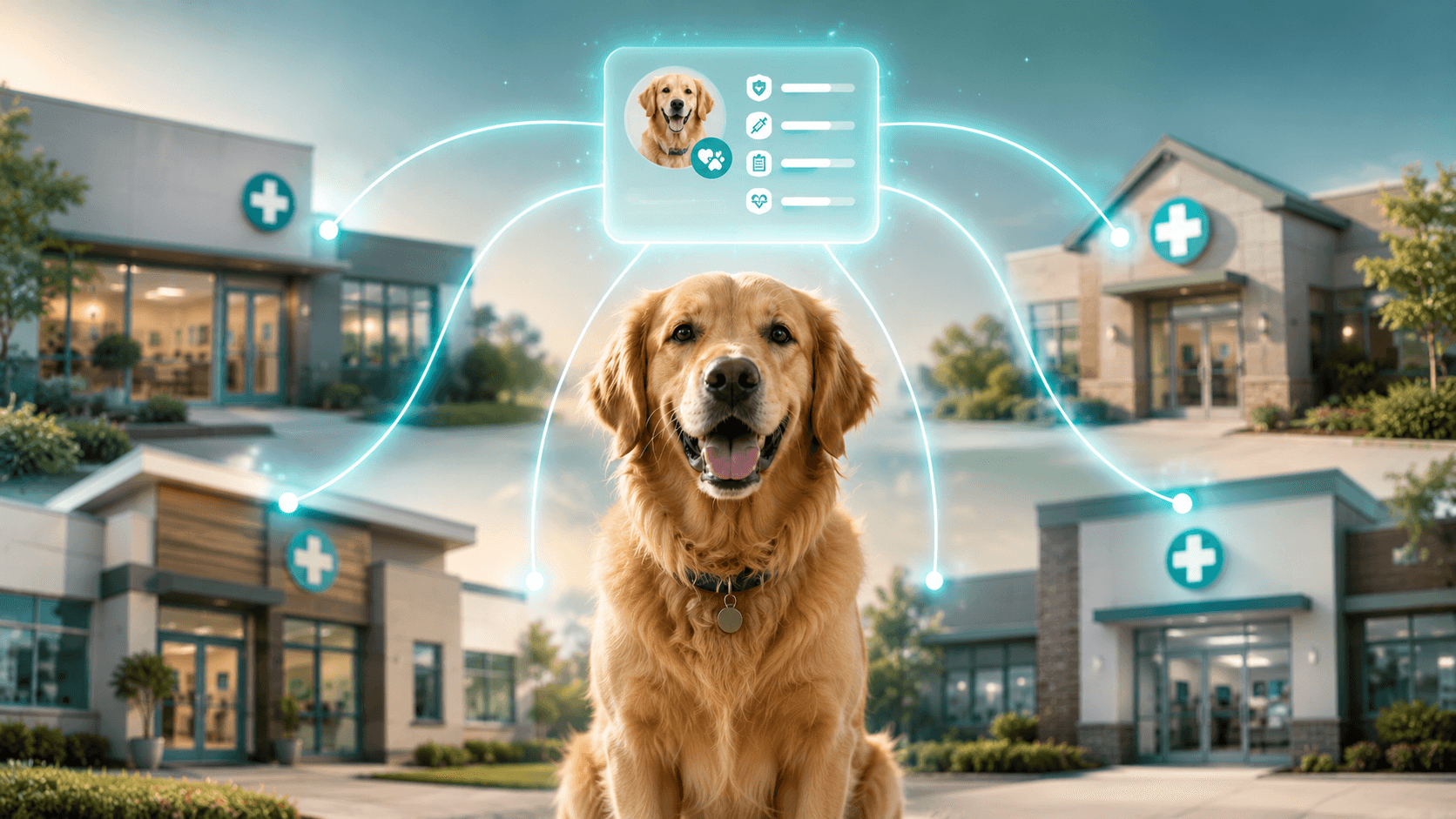
The pet health data problem is that a dog or cat's medical history is scattered across paper records, clinic-specific software, owner phone photos, and disconnected registries — so the one entity the data is actually about, the animal, has no continuous record of its own. This is the quiet structural flaw beneath a booming industry, and it is worth understanding clearly, because the company that resolves it sits underneath everything else.
A large market built on disconnected silos
Start with scale. According to FEDIAF's 2025 Facts & Figures, roughly 139 million European households — about 49% — own a pet. The EU alone counts 69.36 million dogs and 80.97 million cats, with close to 299 million pets across Europe overall.
That population sustains a serious healthcare economy. Mordor Intelligence values the European veterinary healthcare market at approximately USD 16.92 billion in 2025, growing to USD 23.32 billion by 2030 at a 6.62% CAGR. Layered on top is a fast-growing software market: the global veterinary software sector was estimated at USD 1.43 billion in 2024 and is projected to reach roughly USD 3.01 billion by 2030, led by players such as IDEXX, Covetrus, and Nordhealth.
Capital has noticed. Pet tech alone saw USD 346 million in equity funding across 37 rounds in 2025, more than double the prior year, with cloud veterinary platforms like Digitail raising substantial Series B rounds.
So the demand is enormous, the spending is durable, the software is funded — and yet the underlying data remains trapped. Every clinic builds its own island. Every owner becomes a manual courier. The market grows, but the record does not travel.
What "fragmentation" actually means in practice
Fragmentation is an abstract word for a very concrete set of failures. A pet's history typically lives in some combination of:
| Where pet data lives today | Who controls it | Portable? | Machine-readable? |
|---|---|---|---|
| Paper vaccination books and printouts | The clinic / owner's drawer | Manually | No |
| PDFs emailed after a visit | Whoever saved the file | Barely | Rarely |
| Phone photos of documents | The owner | In theory | No |
| Practice management software | The individual clinic | No | Internally only |
| Microchip registries | Multiple separate databases | Lookup only | Partially |
Each row is useful in isolation. Together they form a record that no single party can see end to end — least of all the next veterinarian who needs it.
The microchip case is the sharpest illustration. The technology is excellent: ISO 11784/11785 defines a 15-digit, globally unique identifier readable by standard scanners. Europe has, in effect, already solved universal pet identity at the hardware level. But the registries built on top of it are fragmented across dozens of separate national, regional, public, and private databases. Aggregators such as Europetnet and PETMaxx exist precisely because no single registry is authoritative. A pet can be registered in several databases, one, or none.
We standardised the identifier. We never standardised the record attached to it.
Why this is a welfare problem, not just an inconvenience
It would be easy to file this under "annoying admin." The clinical evidence says otherwise.
A study published in Frontiers in Veterinary Science found roughly five errors per 1,000 patient visits in the surveyed setting. Around 54% were drug-related, communication failures contributed to about 30% of voluntarily reported errors, and 15% of incidents caused patient harm. Many of these are exactly the kind of mistake a complete, accessible history is designed to prevent: a missed allergy, a duplicated medication, a vaccination given too early because the prior record was unavailable.
When a pet changes clinic, moves city, travels across an EU border, or arrives at an emergency practice at night, the receiving veterinarian frequently starts from near zero. The owner becomes the data layer — reconstructing history from memory and a phone camera roll. That is a fragile foundation for medical decisions about a living animal.
Why the problem has persisted
If the cost is this clear, why hasn't it been fixed? Several forces hold the status quo in place.
Incentives favour lock-in
Practice management software is sold to clinics, not to pets or owners. A clinic's records are a retention asset; making them effortlessly portable can feel like helping a patient leave. Vendors optimise for the buyer, which means data interoperability is rarely the priority — a dynamic worth weighing carefully when comparing practice management tools against true health infrastructure.
Consolidation concentrates data without unifying it
European veterinary services are corporatising. Analyses from L.E.K. Consulting and academic research point to roughly 16% of European vets now operating within consolidated, often private-equity-backed groups. Consolidation pools clinics under common ownership, but it tends to create larger silos rather than open ones. Two corporate groups still cannot read each other's records — and neither can the owner.
No one owns the gap
Microchip standards bodies handle identity. Software vendors handle workflow. Clinics handle care. Registries handle lookup. The connective layer between them — a record centred on the animal — has had no natural owner. It is everyone's adjacent problem and no one's core mandate. That is why a record can still live on paper in 2026 despite every individual component being digital.
The default is "good enough"
Fragmentation rarely fails loudly. It fails quietly, one missing allergy or duplicated vaccine at a time, spread across millions of visits. There is no single outage, so there is no single moment that forces a fix.
Why now
The reasons this has persisted are real. But the conditions that kept it unsolved are changing at once — which is what makes the present moment different.
The identifier already exists. ISO microchipping gives every animal a globally unique key. The hardest part of any data system, a reliable primary identity, is already deployed across the continent.
The software market has matured. A robust ecosystem of cloud-native veterinary platforms now exists and is well capitalised. Clinics increasingly expect digital tools — the question has shifted from whether to digitise to how systems connect.
Capital is flowing into the category. Funding momentum in pet and veterinary tech signals that investors see structural opportunity, not just consumer novelty.
And there is a proven precedent in human medicine. Healthcare faced the identical fragmentation a generation ago, and policy plus infrastructure solved it. In the United States, the HITECH Act drove electronic health record adoption from a minority of physicians to around 72% any-EHR adoption by 2012. Closer to home, Hungary launched EESZT, a national eHealth interoperability backbone, in 2017 — making a citizen's records readable across providers with the patient's consent. The lesson from the human EHR revolution for veterinary medicine is that interoperability does not emerge from market competition alone; it requires a shared standard and a neutral layer everyone can build on.
What the solution actually looks like
The fix is not another clinic app. It is an architectural inversion: make the pet the central entity, not the clinic.
In that model, a pet's record is anchored to its microchip identity and travels with the animal for life. The owner controls access through consent. Clinics do not just read the record — they contribute to it, so every visit enriches a continuous history rather than spawning a fresh island. Any compliant software, from any vendor, can interconnect through a shared protocol. It is, in effect, an EESZT for pets.
This is the layer Petezy is building, and it is worth being precise about the stage: this is early work, infrastructure under construction rather than a finished, fully shipped system. The approach has three parts that reinforce each other:
A free owner app that gives every pet a health profile, vaccination tracking, reminders, a shareable passport, and appointment booking — putting the owner in control of access.
Clinic tools that let practices manage records, automate follow-ups, communicate with owners, and work from shared profiles, priced per active patient so adoption scales with use.
A universal data layer — a standardised pet-passport protocol so any pet software can interconnect rather than competing to hoard data.
The route to a real standard runs through veterinary chambers and associations. Standards in healthcare are not won by a single vendor declaring victory; they are adopted by the institutions that set professional norms. That is the difference between another data island and genuine shared infrastructure.
The strategic read for investors and partners
Strip away the product detail and the thesis is simple. There is a continent-scale population of animals, a multi-billion-euro and growing care economy, a solved identity standard, a maturing software ecosystem, rising capital, and a proven precedent from human health — and the one thing missing is the connective layer that lets the data move with the animal. For partners and chambers, the question is who they want that neutral layer to be: an open standard built with the profession, or a closed silo built around it.
That gap is not a niche feature. It is the foundation the rest of the category will eventually be built on. If you want to understand why this matters at the level of a single animal, start with why your vet doesn't have your pet's full medical history — the everyday version of the same structural problem.
If you are an investor, a clinic group, or a veterinary chamber thinking about where pet health data should live over the next decade, Petezy welcomes a conversation about building this layer the right way.
FAQ
How big is the pet health market this problem affects?
Europe has roughly 299 million pets across about 139 million households, and the European veterinary healthcare market is valued at around USD 16.92 billion in 2025, projected to reach USD 23.32 billion by 2030. The fragmentation problem sits underneath all of that activity.
Doesn't the microchip already solve this?
The microchip solves identity, not records. ISO 11784/11785 gives each animal a globally unique 15-digit ID, but the registries built on it are split across many separate databases, and none of them carries the pet's full medical history. The identifier is the foundation; the connected record still has to be built.
Why is fragmented data a clinical risk and not just an inconvenience?
Because missing history drives preventable errors. A Frontiers in Veterinary Science study found communication failures contributed to about 30% of voluntarily reported errors, most errors were drug-related, and 15% of incidents caused patient harm — the kinds of mistakes a complete, accessible record helps prevent.
Hasn't a problem like this been solved before?
Yes, in human medicine. Policy and infrastructure drove physician EHR adoption to around 72% by 2012 in the US, and Hungary's EESZT made records interoperable across providers from 2017. Those examples show that a neutral, standardised layer is what unlocks interoperability.
What is Petezy building, exactly?
A unified, portable pet health data layer that makes the pet the central entity. It includes a free owner app, paid clinic tools, and a universal pet-passport protocol so any pet software can interconnect.
Why work through veterinary chambers?
Because standards in healthcare are adopted by the institutions that set professional norms, not declared by a single vendor. Chambers and associations are the credible route to a shared standard that clinics and software providers will actually trust and use.