The Difference Between Practice Management Software and Pet Health Infrastructure
Key takeaways
Practice management software (PMS) is built to run one clinic's operations — scheduling, invoicing, inventory, records by client and visit.
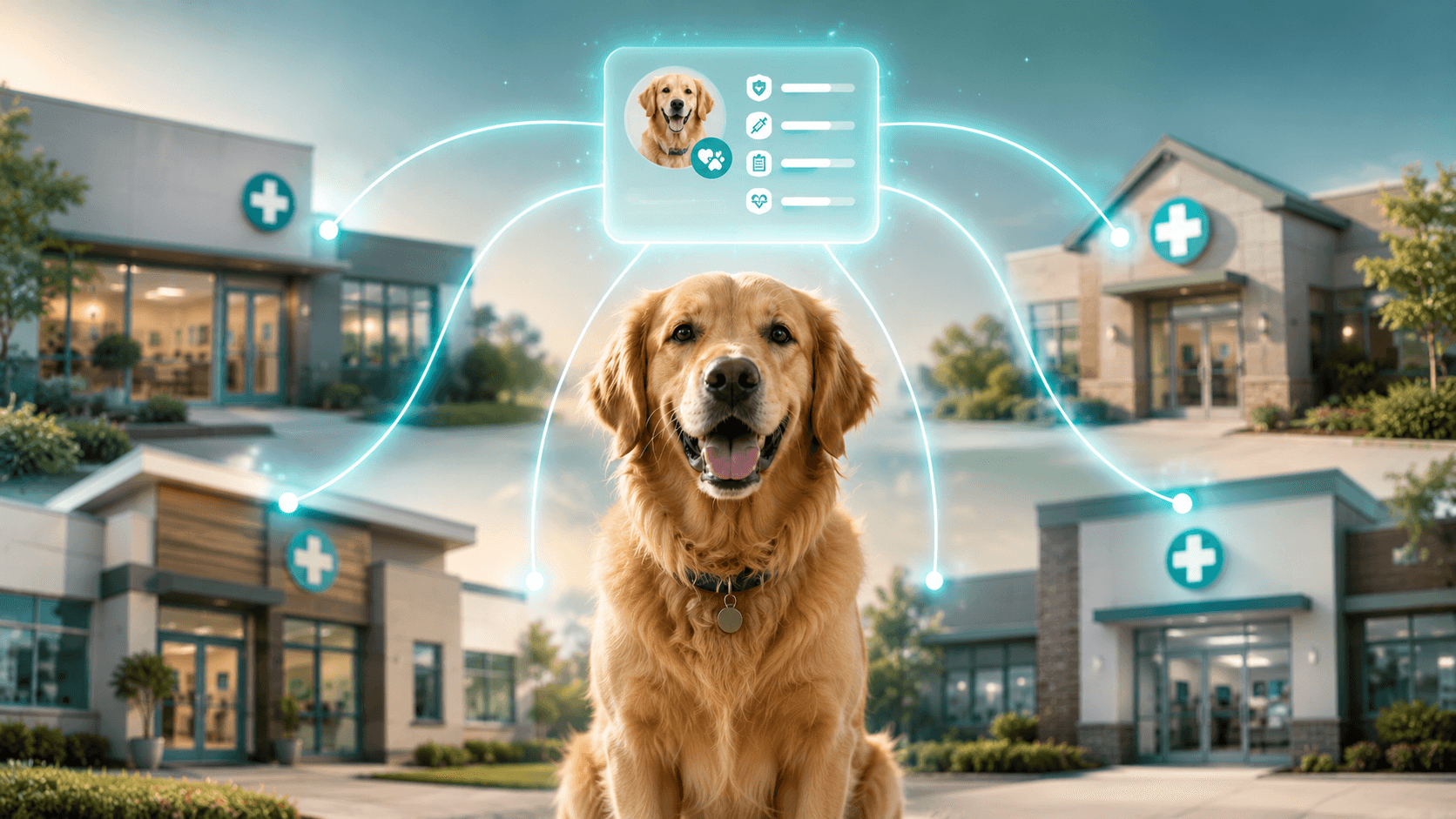
Pet health infrastructure is built to connect the pet's record across clinics — portable, owner-controlled, readable and writable by any authorized provider.
They are not competitors. One organizes the clinic; the other organizes the animal's history.
The veterinary software market is large and growing — but it is overwhelmingly PMS, which leaves the cross-clinic layer largely unbuilt (Grand View Research).
Treating these as the same category is why most clinics are "digital" yet still fragmented.
There is a category confusion at the heart of veterinary software, and it costs clinics clarity when they make buying decisions.
Practice management software and pet health infrastructure solve different problems — a PMS makes your clinic run, while infrastructure makes the pet's record travel — and conflating the two is why so many "fully digital" clinics still cannot answer a simple question: what is this animal's complete medical history?
This article draws the line cleanly, because once you see it, your software stack makes a lot more sense.

What practice management software is for
A veterinary PMS — ezyVet, Covetrus Pulse, IDEXX systems, Shepherd, and others — is operational software. It exists to run the business of one practice.
Its core jobs:
Scheduling appointments and managing the calendar.
Invoicing and payments, increasingly with charge capture built in.
Inventory and pharmacy management.
Medical records stored for that clinic's use.
Reporting on the clinic's performance.
Crucially, a PMS organizes data around the client and the invoice inside that clinic. That is the right design for running a practice. The market reflects how essential this is: the veterinary software market was valued in the low billions and is projected to keep growing at double-digit rates, with practice management systems making up the majority of it (Grand View Research, Business Research Insights).
A PMS is excellent at what it does. The issue is what it was never designed to do.
What pet health infrastructure is for
Pet health infrastructure is a different layer entirely. It is not operational software for one clinic — it is a connective layer that holds the pet's record and lets it move.
Its core properties:
Pet-centric. The record is organized around the animal, not around any single clinic's client list or invoices.
Portable. The history travels with the pet — to the next vet, the emergency hospital, the boarding facility, across borders.
Owner-controlled consent. The owner decides who can access the record, and grants or revokes that access.
Bidirectional. Authorized clinics can both read the record and contribute to it, so it stays current no matter who provides care.
Interoperable. It is designed to connect to clinic PMS, insurance, pharmacy, and devices rather than replace them.
If a PMS is the operating system of one clinic, infrastructure is closer to the rails between clinics — the equivalent of what a shared electronic health record exchange does in human medicine.

Side by side
| Dimension | Practice Management Software | Pet Health Infrastructure |
|---|---|---|
| Primary user | The clinic | The pet (and its owner) |
| Data organized around | Client, visit, invoice | The animal's lifetime record |
| Scope | One practice | Across all providers |
| Record movement | Stays in the clinic | Travels with the pet |
| Access control | Clinic staff | Owner-controlled consent |
| Direction | Clinic reads/writes its own data | Any authorized clinic reads and contributes |
| Replaces the other? | No | No — complements the PMS |
| Examples | ezyVet, Covetrus Pulse, IDEXX, Shepherd | Petezy (early-stage) |
The most important row is the last functional one: infrastructure does not replace your PMS. It connects to it. A clinic can keep running ezyVet or Covetrus Pulse and still plug into a portable record layer so the pet's history is complete on arrival and stays complete after the pet leaves.
Why the distinction matters operationally
This is not academic. The confusion has concrete consequences.
Fragmentation survives even when everyone is digital
The veterinary field is described as "extremely fragmented," with corporate groups running proprietary systems and private clinics acting as individual silos (IEEE Pulse). Every clinic having excellent PMS does not fix this — it produces many excellent, disconnected silos. Continuity of care becomes impossible when none of the information from one visit reaches the next provider (Blender Solutions).
You pay twice for the same gap
Because the PMS does not hold cross-clinic history, clinics re-collect it manually — owners are asked for records they already provided, diagnostics get repeated, and staff burn time reconciling. That is the documentation and admin load that already eats 25–40% of a vet's day (PawfectNotes) and feeds the missed-charge problem worth up to $60,000 per doctor per year (Shepherd).
Buying decisions get distorted
When clinics evaluate "veterinary software," they compare PMS against PMS and conclude they have solved their records problem. They have solved their operations problem. The portability problem is a different purchase entirely — and one most vendors in the PMS category are not built to address.
The human-medicine parallel
Human healthcare went through this exact split. Hospitals and clinics run their own systems (the equivalent of PMS), but national and regional health information exchanges emerged to let a patient's record follow them between providers. Hungary's EESZT is one such system: a national layer that connects otherwise separate institutions.
Veterinary medicine has the clinic-level software but largely lacks the connective layer. Building that layer for pets — an "EESZT for pets" — is the long-term thesis behind Petezy. It is infrastructure, not a PMS, and it is designed to interconnect with the PMS clinics already run, plus insurance, pharma, and devices over time. Petezy is early-stage and still building this out, but the category distinction is the whole point: the missing piece in veterinary software is not a better PMS, it is the rails between them.
How to think about your stack
A useful frame for any clinic:
Keep your PMS for what it is great at — running the clinic.
Add infrastructure for what the PMS cannot do — making the pet's record complete on arrival and portable on departure.
Refuse the false choice. You are not picking one over the other. The goal is a PMS that runs your operations sitting on top of infrastructure that connects the pet's history across the wider system.
When you separate these two jobs in your mind, the "we are already digital but still fragmented" paradox finally resolves — and you can target spending at the layer that actually closes the gap.
Suggested images
IMAGE 1 — Hero, top of article. Prompt: A clean, modern editorial illustration showing two distinct layers: a lower layer of individual clinic "buildings" each with its own self-contained system, and an upper connective layer of glowing rails/nodes linking them, with a pet (dog/cat silhouette) icon traveling along the upper layer. Flat vector style, teal and coral on off-white, conveys infrastructure connecting clinics. No text. Aspect ratio 16:9. Alt text: Illustration of separate veterinary clinics connected by an upper layer of pet health infrastructure.
IMAGE 2 — Inline, before "Side by side." Prompt: A photorealistic split-frame image: left side shows a single tidy clinic front desk with one computer (representing practice management software); right side shows an abstract glowing network of connected pet records spanning multiple locations. Cohesive lighting bridges both halves. Teal and white palette. No text. Aspect ratio 16:9. Alt text: Split image comparing a single clinic workstation with a connected pet health record network.
FAQ
Is Petezy a practice management system?
No. Petezy is pet health infrastructure — a portable, pet-centric record layer designed to connect to the PMS a clinic already runs, not replace it.
Do I have to choose between a PMS and pet health infrastructure?
No. They solve different problems. A PMS runs your clinic's operations; infrastructure makes the pet's record portable across providers. The two are designed to work together.
Why isn't a good PMS enough to solve fragmentation?
Because a PMS organizes data around one clinic's clients and invoices. Even when every clinic has excellent software, the result is many disconnected silos, and the pet's history still does not travel between them (IEEE Pulse).
What does "EESZT for pets" mean?
EESZT is Hungary's national health data exchange that connects human healthcare institutions. "EESZT for pets" describes a comparable connective layer for veterinary records — infrastructure that lets a pet's history follow it across clinics.
Can infrastructure connect to ezyVet, Covetrus Pulse, or IDEXX systems?
That is the design intent of pet health infrastructure — to interoperate with existing practice management systems rather than compete with them. Petezy is building toward this.
Sources
Veterinary Software Market Size & Share Report — Grand View Research
Veterinary Practice Management Software Market — Business Research Insights
Electronic Health Records in Veterinary Medicine — IEEE Pulse
The Problem With Disconnected Pet Health Records — Blender Solutions
How to Reduce or Eliminate Missed Charges — Shepherd Veterinary Software